 |
Helping More Students |

The Institute is the only Hong Kong institution providing open access to working adults for undergraduate level study. All Hong Kong residents aged 17 or above can apply to study for most courses at the Institute. Only certain professional upgrading programmes in Education, Nursing and Business Administration have specific entry requirements.
The profile of the Institute's student body continued to be diverse, consisting of people from all walks of life. More than half of them were aged between 26 and 35, with the youngest being 17 and the oldest 75. The majority were married and more than 95 per cent held a full time job.
Ensuring flexibility
The Institute recognizes that flexibility is essential to people who have to balance their study, family and work commitments. It adopts a credit accumulation method to enable students to proceed with studies at their own pace. The distance learning approach - using self-instructional texts, television programmes and other audio-visual aids, computers, and face- to-face and telephone tutorials - has enabled students to plan their study according to individual needs.

OUHK signs a credit transfer agreement with the Middlesex University, U.K. |
Students are also able to count credits obtained elsewhere towards their OLI degrees. More than 700 applications for advanced standing were processed during the year. In addition, the Institute has credit transfer agreements with a number of overseas universities and it recognizes selected degrees from institutions in mainland China for credit transfer. During the year, new agreements were reached with Athabasca University in Canada and Middlesex University in the UK. |
Receiving students and visitors on campus
The OLI Students and Visitors Information Centre was established in April 1996 at the new campus. Its main functions are to answer enquiries, distribute marketing literature and sell souvenirs. The Centre has proved to be an effective channel for handling enquiries and marketing services.
Linking students and the Institute
The student Affairs Office, in its second year of operation, continued to provide services and facilities for the well-being of students so that they can take full advantage of the academic opportunities provided by the Institute. Liaising closely with the Students' Union, the Office also acts as a channel for communication between the management of the Institute and its students. It reflects the wishes and needs of students to the policy making bodies and interprets the requirements of the Institute to the students.
The Office handled more than 15,000 enquiries by phone and in person during the year. Information about the Institute is also available through the 24-hour 'InfoExpress', the Institute's interactive voice response system, which has become an increasingly important link between the Institute and its students and the public. The system's 16 lines provide general information, course quota, course allocation, course material and admission details, etc., and allow students to choose their tutorial locations and times. Information is also available by facsimile. Over 110,000 calls were received during the year.
Counselling seminars were organized regularly to introduce to prospective students information about programmes and advanced standing, and various aspects of study life at the Institute. About 2,200 participants attended 21 counselling seminars during the year.
More aid and scholarships
The Office also handles the Student Financial Assistance Scheme, which provides bursaries or loans for students who encounter financial difficulties in paying for their tuition. Students who have passed at least one credit-bearing degree or articulated sub-degree course are eligible to apply. Funds for bursaries were donated by commercial organizations and individuals. Student loans, available at a very low interest of only three per cent per annum, are financed by a government grant of $50 million.
The Scheme received more than 1,000 applications during each semester of the year, and more than HK$14.8 million was disbursed. Depending on the applicant's financial situation, either a bursary, a 'Pay on Graduation' loan, or a 'Pay As You Learn' loan was offered.
On the other hand, scholarships were awarded to students with outstanding academic performance. The number of scholarship schemes increased from two to 12 and the number of recipients grew from 18 to 37.
During the year, renowned entrepreneur Dr Fong Yun-wah donated $800,000 to the Institute through his Fong's Family Foundation for the erection of a stone status of Confucius on campus, and four 'Fong Yun-wah Learning for All Scholarships' and four bursaries annually.
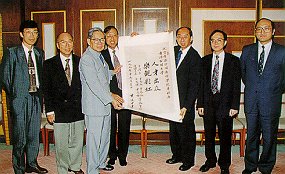
Philanthropist Dr Fong Yun-wah presents a scroll of Chinese calligraphy to the Institute to commemorate its upgrade to university status. |
Other new scholarship awards were the Bank of China Group - OLI Scholarship, the Chen Hsong Industrial Scholarship, the Wing Hang Bank Scholarship, the Woo Hon-fai Memorial Scholarship, the Vincent Woo Wing-fai Scholarship, the Dr Lee Kin- hung Scholarship, the Henry S T Tam Memorial Scholarship and the Thomas Cheung Foundation Ltd. Scholarship. The Citibank and Exxon Energy Ltd continued to donate |
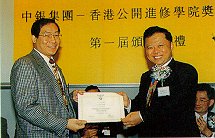
The Bank of China Group - OLI scholarship Award Ceremony. |
The Hongkong Bank Foundation, the Hsin Chong - K. N. Godfrey Yeh Education, the Jessie and Thomas Tam Foundation and the Lee Hysan Foundation have been long- standing bursary donors to the Institute. New bursary donors included Mr Kan Fook- yee, Fuji Photo Products Co Ltd, Mr Kenneth Ting and Dr Tso Wung-wai. |
Several new bursaries for students with disabilities were set up with donations from Shui On Centre Co. Ltd., Dr Patrick Ho and the Lippo Group. The Zonta Club of Victoria has also sponsored people with disabilities to study at the Institute for the past two years.
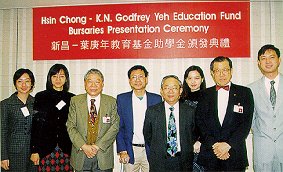
|
A helping hand for special students
As of October 1996, the Institute had 64 students with different disabilities. A range of services including counselling advice, special course materials, suitable tutorial venues, special examination arrangements and the loan of learning equipment is provided to facilitate their learning at the Institute.
With the help of an $860,000 donation from the Hong Kong Jockey Club Charities Trust, a Disabled Students Centre with a variety of learning aids has been set up. Visually impaired students can use equipment such as powerbraille and a closed- circuit television with enlargement capability in the Centre. Hearing impaired students can borrow notebook computers, external modems and fax machines from the Institute for use at home. New equipment, including a chair lift to help transport wheelchair- bound students between the two floors of the Library, was set up during the year.
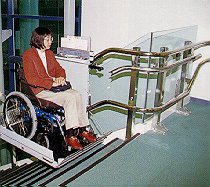
A graduate tries out the chairlift for wheelchair bound people. |
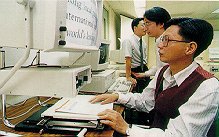
Closed-circuit television with enlargement capability is one of the specially-designed equipments available for loan by disabled students. |
Special assistance is also available for the elderly, the institutionalized and students on overseas trips. Students aged 65 or above can apply for a tuition fee reduction of 30 per cent. The Bursary Fund for Prison Inmates, initiated by Council member Dr Tam Man-kwan, received new donations from the K P Tin Foundation, Mr Vincent Woo Wing-fai and various donors. More than 100 examinations were held for the disabled and students in prisons or outside Hong Kong.
Library and study facilities improved
Library services improved considerably with the move of the Institute from Mong Kok to Ho Man Tin. The number of study seats increased from 91 to 304 and individual study carrels were introduced. Shelf space for both books and serials has also been greatly increased.
The Library's collection of books, serials, audio-visual materials and CD-ROMs continued to grow. The Library's CD-ROM networking project was completed. It enables users to access about 30 CD-ROM research databases, from within and outside the campus. Students can check the Institute's Library catalogue and their borrowing status through the Internet.
Borrowing services for students began in October 1996. Project-based and postgraduate students can also use the inter- library loan service to get materials from libraries of local universities.
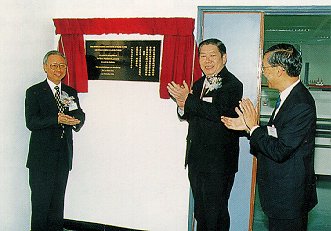
Opening ceremony of the Lee Hysan Science Laboratories. |
A modern Language
Laboratory with 32 seats
was set up within the
Library. A fully-equipped
audio-visual centre with
VCRs, TVs, CD players
and cassette tape
recorders was opened for
use by students and staff.
The Lee Hysan Science Laboratories, funded by a $6 million donation from the Lee Hysan Foundation, were formally opened in October |
The Trust further donated $3 million to the Institute for procuring equipment in the Technology Laboratory for the training of students in the honours degree programmes in electronics and engineering mechanics.
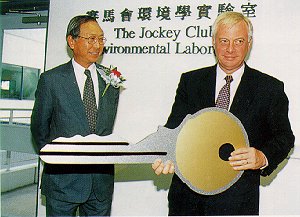
Hongkong Jockey Club Chairman Mr Wong Chung-hin presents a giant key to former OUHK President Governor Mr Chris Patten to symbolize the transfer of the Environmental Laboratory to the OUHK. |
Understanding the needs of students
In order to understand better the needs of students and graduates, the Institute conducted a number of regular and ad hoc surveys during the year. Major areas examined included students' lifestyle, career and education development of graduates, continued benefits to inactive students and the information technology needs of students.
The Quality Improvement Team, established in 1994 to build a quality culture within the Institute, reviewed various areas of student services, including assignment handling procedures, tutor-student relations and the grade award system, and completed the project on rationalizing quality assurance procedures. During the year the Team also began to administer the Institute's end-of-semester student surveys which provide feedback on the quality of course presentations.
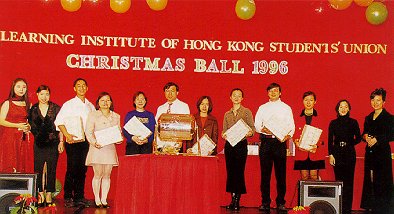
Christmas Ball orgnaized by the Students' Union. |
Student and graduate roundtables have been held regularly. They provide an informal opportunity for the Institute's students to share with each other their experiences about study, career and aspirations, as well as to exchange views with staff on how best the Institute can perfect its services.
Working closely with the Institute to provide welfare and support for students is the Students' Union. Representatives of the Students' Union reflect views of students at Council and Academic Board meetings.
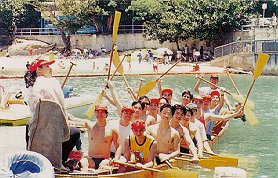
Students preparing for the Dragon Boat Festival. |
Together with two affiliated bodies - the Environmental Studies Society and the Chinese Society - the Students' Union organized many educational, welfare and fund-raising activities including the sale of old books, student surveys, academic seminars, Putonghua classes, voluntary work, and visits to mainland universities. The Environmental Studies Society also helped test the quality of tap water in Ma On Shan following reports of contamination.
Two new affiliated bodies - the Information Technology Society and the Dragon Boat Team - were formed. The Information Technology Society set up a Web site on the Internet for better communication between the Union and students. Two publications, Olivine, and the Environmental Studies Society Newsletter, continued to keep students informed about Union activities.
The MBA Association and the Alumni Association also came into existence. The Alumni Association held its first general meeting in February and successfully recruited 300 members.
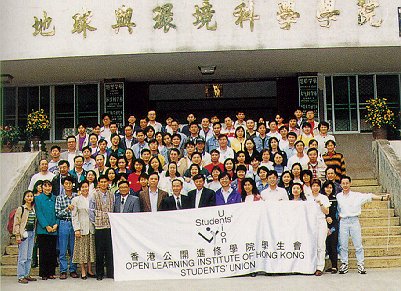
A visit to the mainland by the Environmental Studies Society. |
 |
 |
 |
[HOME] [University Profile ] [Mission Statements ] [Contents ]
Copyright 1997 The Open University of Hong Kong
For comments and suggestions, please contact webmaster@ouhk.edu.hk
For enquiry on admission, study and courses, please contact regwww@ouhk.edu.hk