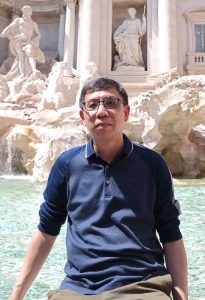
CRANT Talks Series: Coded Computing: How to Utilize Fast Workers in Heterogenous Systems?
Speaker: Professor Albert Chi Wan Sung (CityU) & Ms Jiajun Chen (Ph.D. Student of CityU) Organizer: CRANT, S&T Date: 20 June 2023 (Tuesday) Time: 10:30 AM – 12:00 PM Location: Presidents' Chamber (E0814), Jockey Club Campus (JCC), HKMU
Title
Coded Computing: How to Utilize Fast Workers in Heterogenous Systems?
Abstract
The widespread use of machine learning and big data has led to a surge in demand for computational power. To efficiently train learning models, computation tasks are often offloaded to distributed servers, or workers, which can compute in parallel to speed up the process. However, the workers may not be trustworthy, which raises data privacy concerns. Moreover, they may suffer from straggling or outages, causing delays or even complete failures. Researchers have adopted coding techniques originally designed for error correction to address these challenges to ensure data privacy and enhance system resilience against slow or unresponsive workers.
This seminar will be divided into two parts. The first part will introduce the concept of coded computing and highlight the challenge of dealing with heterogeneous worker speeds, particularly in edge computing scenarios where no prior knowledge of worker speeds is available. The selection of workers is formulated as a multi-armed bandit problem, solved by a reinforcement learning method called Thompson sampling. In the second part, the complementary scenario of multi-cloud computing will be considered, where there is complete knowledge of worker speeds. The fundamental tradeoff between storage and computing under security constraints is analyzed via information theory, and the impact of heterogeneity is characterized via majorization theory. The talk will then conclude by discussing future directions in this emerging field. Attendees will gain insights into the latest advances in coded computing and its potential for improving the efficiency and resilience of distributed learning systems.
Biographies
Albert Sung is an Associate Professor and the Associate Head of Undergraduate Programmes in the Department of Electrical Engineering at City University of Hong Kong. He holds a B.Eng, M.Phil, and Ph.D, all in Information Engineering, from the Chinese University of Hong Kong. His research interests span broad areas of communications, coding, and computing, with a specific focus on resource allocation for mobile networks, code constructions for distributed storage systems, and the design and analysis of evolutionary algorithms. In recognition of his contribution to the field, he has been included in the list of top 2% most highly cited scientists complied by Stanford University since 2020. He also serves on the editorial boards of the ETRI Journal and Electronics Letters.
Jiajun Chen is a Ph.D. student in the Department of Electrical Engineering at City University of Hong Kong. She received the B.S. degree from Sichuan University, Chengdu, China, in 2018. She has a journal paper published in IEEE Transactions on Information Theory (TIT) in 2023. Her research interests include coded distributed computing, information theory, and resource allocation.
Graduates becomes entrepreneur to realize his dream in Science Park
Jonathan Chiu
Marketing Director
3DP Technology Limited
Jonathan handles all external affairs include business development, patents write up and public relations. He is frequently interviewed by media and is considered a pioneer in 3D printing products.
Engineer working side-by-side with medical doctors in hospital
Krutz Cheuk
Biomedical Engineer
Hong Kong Sanatorium & Hospital
After graduating from OUHK, Krutz obtained an M.Sc. in Engineering Management from CityU. He is now completing his second master degree, M.Sc. in Biomedical Engineering, at CUHK. Krutz has a wide range of working experience. He has been with Siemens, VTech, and PCCW.
Award-winning inventor turns ideas in medical products
Hugo Leung
Software and Hardware Engineer
Innovation Team Company Limited
Hugo Leung Wai-yin, who graduated from his four-year programme in 2015, won the Best Paper Award for his ‘intelligent pill-dispenser’ design at the Institute of Electrical and Electronics Engineering’s International Conference on Consumer Electronics – China 2015.
The pill-dispenser alerts patients via sound and LED flashes to pre-set dosage and time intervals. Unlike units currently on the market, Hugo’s design connects to any mobile phone globally. In explaining how it works, he said: ‘There are three layers in the portable pillbox. The lowest level is a controller with various devices which can be connected to mobile phones in remote locations. Patients are alerted by a sound alarm and flashes. Should they fail to follow their prescribed regime, data can be sent via SMS to relatives and friends for follow up.’ The pill-dispenser has four medicine slots, plus a back-up with a LED alert, topped by a 500ml water bottle. It took Hugo three months of research and coding to complete his design, but he feels it was worth all his time and effort.
Hugo’s public examination results were disappointing and he was at a loss about his future before enrolling at the OUHK, which he now realizes was a major turning point in his life. He is grateful for the OUHK’s learning environment, its industry links and the positive guidance and encouragement from his teachers. The University is now exploring the commercial potential of his design with a pharmaceutical company. He hopes that this will benefit the elderly and chronically ill, as well as the society at large.
Soon after completing his studies, Hugo joined an automation technology company as an assistant engineer. He is responsible for the design and development of automation devices. The target is to minimize human labor and increase the quality of products. He is developing products which are used in various sections, including healthcare, manufacturing and consumer electronics.
Course Code
Title
Credits
COMP S321F
Advanced Database and Data Warehousing
5
COMP S333F
Advanced Programming and AI Algorithms
5
COMP S351F
Software Project Management
5
COMP S362F
Concurrent and Network Programming
5
COMP S363F
Distributed Systems and Parallel Computing
5
COMP S382F
Data Mining and Analytics
5
COMP S390F
Creative Programming for Games
5
COMP S492F
Machine Learning
5
ELEC S305F
Computer Networking
5
ELEC S348F
IOT Security
5
ELEC S371F
Digital Forensics
5
ELEC S431F
Blockchain Technologies
5
ELEC S425F
Computer and Network Security
5
Course Code
Title
Credits
ELEC S201F
Basic Electronics
5
IT S290F
Human Computer Interaction & User Experience Design
5
STAT S251F
Statistical Data Analysis
5
Course Code
Title
Credits
COMPS333F
Advanced Programming and AI Algorithms
5
COMPS362F
Concurrent and Network Programming
5
COMPS363F
Distributed Systems and Parallel Computing
5
COMPS380F
Web Applications: Design and Development
5
COMPS381F
Server-side Technologies and Cloud Computing
5
COMPS382F
Data Mining and Analytics
5
COMPS390F
Creative Programming for Games
5
COMPS413F
Application Design and Development for Mobile Devices
5
COMPS492F
Machine Learning
5
ELECS305F
Computer Networking
5
ELECS363F
Advanced Computer Design
5
ELECS425F
Computer and Network Security
5
This site is registered on wpml.org as a development site.