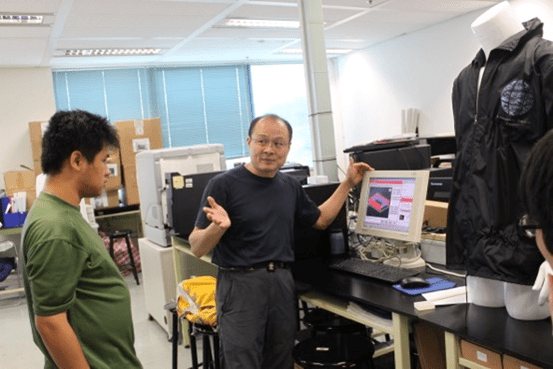
Industrial Training is a compulsory course for Year 2 Electronic and Computer Engineering students.It emphasizes the practical experiences that complement the theories covered in other courses of the programme.
Students will need to attend 140 hours of in-house practical training in the electronic laboratory and computerlaboratory in their first summer term. The training sessions cover topics on industrialsafety, electronic testing methodologies, building electronic circuits, design and fabrication of printed circuit board (PCB), microcontroller applications, virtual instrumentation, product prototyping, computer-aided design and manufacturing (CAD / CAM), and computer network setup.
Safety Training
The workplace can be very dangerous, especially for electronic and computer engineers. Since they need to deal with various machines every day. Improper behaviors or low safety awareness would cause accidents and leads to irreparable injury.
In industrial training, we provide safety training to students. Tell them the importance of health and safety in working place for workers and general public, the key factors which will lead to hazards, the safety law and standard they need to obey and also the safety measure they should do to prevent the dangers in works.
After the course, students should have knowledge of basic occupational health and industrial safety requirements for engineering practice.
Electronic Practices
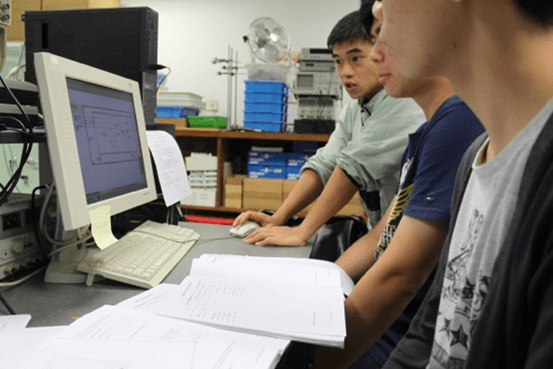
In this part, we provide students a chance to practice with various electronic components in both hardware and software aspect. Students need to choose basic electronic components based on technical requirements by considering size, lead count, power dissipation, field operating conditions and cost.
Also, they need to use basic test instruments, such as lab DC power supply, digital multimeter, oscilloscope, function generator to perform test on diode, LED and NPN transistor. Besides, they can use solder and Altium Designer 10 software to work on SMT components and Printed Circuit Board (PCB). Through this students should gain technical skills for future career and studies.
3D Printer – Product Prototype
3D Printing is one of the emerging electronic technologies nowadays. It is an additive process of making three dimensional solid objects from a digital model. In the process an object is created by laying down successive layers of material until the entire object is created.
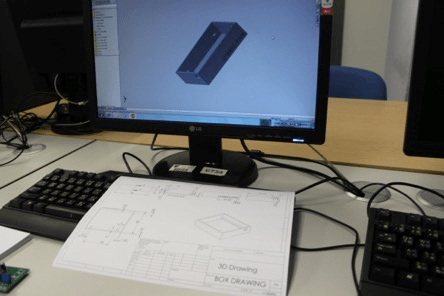
In this training, we provide students a chance to practices with 3D printers. They need to first use SolidWorks software to create a 3D objects, then export a solid model in STL format. Furthermore they can also learn rapid prototyping (RP) technologies and create their prototype by using 3D printer

Practices with Virtual Instruments
We are not just focusing on hardware, but also provide software training. During the industrial training, students can learn how to use virtual instruments in LabVIEW software to acquire, analyze and present data.
Also, students need to implement codes and debug their selves incase to develop modular application and create data structures in LabVIEW. Through this training we hope students can familiar with common electronic software, and prepare for future career and study.
Microcontroller Design
Microcontroller is an important factor in electronic design. During the industrial training, students can learn the basic electronic components in microcontroller and how they function in it.
Also, students need to use soldering skills to build a battery-operated & MCU-based standalone system on the breadboard. Through this we hope student can apply their knowledge learned in previous studies together to build an electronic prototyping board.

Setup Computer Network
Our training not only includes electronic part, but also includes computer network. In computer network section, students can learn the knowledge about TCP/IP communication, different kinds of network components, wireless technology and low layer network security.
Besides, students can also hands on in making straight-through LAN cable, configure WAN, LAN and wireless connections on routers, use specific tools to get network information and configure IP address. Through this student can learn basic computer network knowledge and have practical experiences for future studies.

Jonathan handles all external affairs include business development, patents write up and public relations. He is frequently interviewed by media and is considered a pioneer in 3D printing products.

After graduating from OUHK, Krutz obtained an M.Sc. in Engineering Management from CityU. He is now completing his second master degree, M.Sc. in Biomedical Engineering, at CUHK. Krutz has a wide range of working experience. He has been with Siemens, VTech, and PCCW.

Hugo Leung Wai-yin, who graduated from his four-year programme in 2015, won the Best Paper Award for his ‘intelligent pill-dispenser’ design at the Institute of Electrical and Electronics Engineering’s International Conference on Consumer Electronics – China 2015.
The pill-dispenser alerts patients via sound and LED flashes to pre-set dosage and time intervals. Unlike units currently on the market, Hugo’s design connects to any mobile phone globally. In explaining how it works, he said: ‘There are three layers in the portable pillbox. The lowest level is a controller with various devices which can be connected to mobile phones in remote locations. Patients are alerted by a sound alarm and flashes. Should they fail to follow their prescribed regime, data can be sent via SMS to relatives and friends for follow up.’ The pill-dispenser has four medicine slots, plus a back-up with a LED alert, topped by a 500ml water bottle. It took Hugo three months of research and coding to complete his design, but he feels it was worth all his time and effort.
Hugo’s public examination results were disappointing and he was at a loss about his future before enrolling at the OUHK, which he now realizes was a major turning point in his life. He is grateful for the OUHK’s learning environment, its industry links and the positive guidance and encouragement from his teachers. The University is now exploring the commercial potential of his design with a pharmaceutical company. He hopes that this will benefit the elderly and chronically ill, as well as the society at large.
Soon after completing his studies, Hugo joined an automation technology company as an assistant engineer. He is responsible for the design and development of automation devices. The target is to minimize human labor and increase the quality of products. He is developing products which are used in various sections, including healthcare, manufacturing and consumer electronics.
| Course Code | Title | Credits | |
|---|---|---|---|
| COMP S321F | Advanced Database and Data Warehousing | 5 | |
| COMP S333F | Advanced Programming and AI Algorithms | 5 | |
| COMP S351F | Software Project Management | 5 | |
| COMP S362F | Concurrent and Network Programming | 5 | |
| COMP S363F | Distributed Systems and Parallel Computing | 5 | |
| COMP S382F | Data Mining and Analytics | 5 | |
| COMP S390F | Creative Programming for Games | 5 | |
| COMP S492F | Machine Learning | 5 | |
| ELEC S305F | Computer Networking | 5 | |
| ELEC S348F | IOT Security | 5 | |
| ELEC S371F | Digital Forensics | 5 | |
| ELEC S431F | Blockchain Technologies | 5 | |
| ELEC S425F | Computer and Network Security | 5 |
| Course Code | Title | Credits | |
|---|---|---|---|
| ELEC S201F | Basic Electronics | 5 | |
| IT S290F | Human Computer Interaction & User Experience Design | 5 | |
| STAT S251F | Statistical Data Analysis | 5 |
| Course Code | Title | Credits | |
|---|---|---|---|
| COMPS333F | Advanced Programming and AI Algorithms | 5 | |
| COMPS362F | Concurrent and Network Programming | 5 | |
| COMPS363F | Distributed Systems and Parallel Computing | 5 | |
| COMPS380F | Web Applications: Design and Development | 5 | |
| COMPS381F | Server-side Technologies and Cloud Computing | 5 | |
| COMPS382F | Data Mining and Analytics | 5 | |
| COMPS390F | Creative Programming for Games | 5 | |
| COMPS413F | Application Design and Development for Mobile Devices | 5 | |
| COMPS492F | Machine Learning | 5 | |
| ELECS305F | Computer Networking | 5 | |
| ELECS363F | Advanced Computer Design | 5 | |
| ELECS425F | Computer and Network Security | 5 |