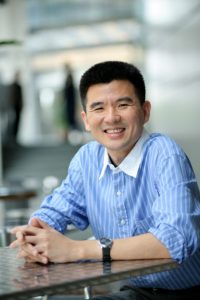
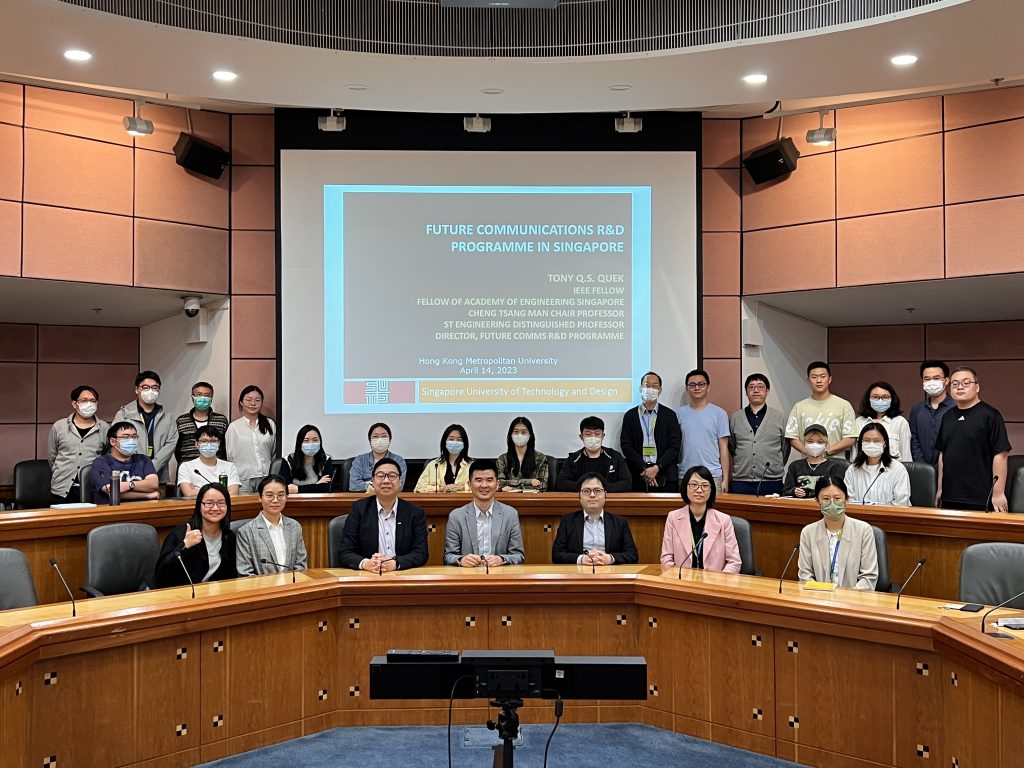
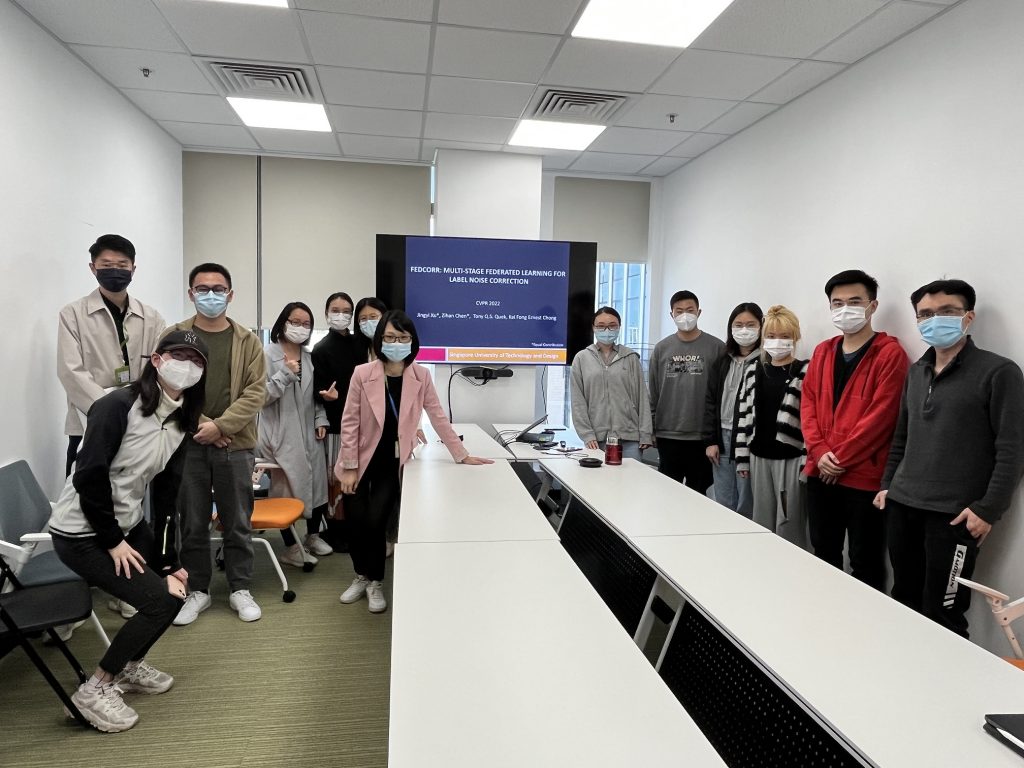
Prof. Tony Q.S. Quek, IEEE Fellow
Talk
Future Communications R&D Programme in Singapore
Abstract
Communications and connectivity have become the critical foundational technology that supports Singapore's economy. Singapore has invested close to S$70 million through the launch of Singapore's first national Future Communications Research and Development Programme (FCP), to jumpstart cutting-edge communications and connectivity research. This grows local capability, to translate into innovative products, services and companies. The programme is hosted by the Singapore University of Technology and Design. FCP encourages collaboration between industry and research ecosystem. It will provide easy access to testbeds to facilitate development of 5G and future communication technologies. FCP seeks to collaborate with R&D partners both domestically and internationally to explore different opportunities to advance capabilities in future communications.
Biography
Tony Q.S. Quek received the B.E. and M.E. degrees in Electrical and Electronics Engineering from Tokyo Institute of Technology, respectively. At Massachusetts Institute of Technology, he earned the Ph.D. in Electrical Engineering and Computer Science. Currently, he is the Cheng Tsang Man Chair Professor with Singapore University of Technology and Design (SUTD) and ST Engineering Distinguished Professor. He also serves as the Head of ISTD Pillar, Director for Future Communications R&D Programme, Sector Lead for SUTD AI Program, and the Deputy Director of SUTD-ZJU IDEA. His current research topics include wireless communications and networking, 6G, network intelligence, non-terrestrial networks, and open radio access network.
Dr. Quek has been actively involved in organizing and chairing sessions and has served as a TPC member in numerous international conferences. He is currently serving as an Area Editor for the IEEE Transactions on Wireless Communications. He was an Executive Editorial Committee Member of the IEEE Transactions on Wireless Communications, an Editor of the IEEE Transactions on Communications, and an Editor of the IEEE Wireless Communications Letters.
Dr. Quek received the 2008 Philip Yeo Prize for Outstanding Achievement in Research, the 2012 IEEE William R. Bennett Prize, the 2016 IEEE Signal Processing Society Young Author Best Paper Award, the 2017 CTTC Early Achievement Award, the 2017 IEEE ComSoc AP Outstanding Paper Award, the 2020 IEEE Communications Society Young Author Best Paper Award, the 2020 IEEE Stephen O. Rice Prize, the 2020 Nokia Visiting Professorship, and the the 2022 IEEE Signal Processing Society Best Paper Award. He is a Fellow of IEEE and a Fellow of the Academy of Engineering Singapore.
Jonathan handles all external affairs include business development, patents write up and public relations. He is frequently interviewed by media and is considered a pioneer in 3D printing products.
After graduating from OUHK, Krutz obtained an M.Sc. in Engineering Management from CityU. He is now completing his second master degree, M.Sc. in Biomedical Engineering, at CUHK. Krutz has a wide range of working experience. He has been with Siemens, VTech, and PCCW.
Hugo Leung Wai-yin, who graduated from his four-year programme in 2015, won the Best Paper Award for his ‘intelligent pill-dispenser’ design at the Institute of Electrical and Electronics Engineering’s International Conference on Consumer Electronics – China 2015.
The pill-dispenser alerts patients via sound and LED flashes to pre-set dosage and time intervals. Unlike units currently on the market, Hugo’s design connects to any mobile phone globally. In explaining how it works, he said: ‘There are three layers in the portable pillbox. The lowest level is a controller with various devices which can be connected to mobile phones in remote locations. Patients are alerted by a sound alarm and flashes. Should they fail to follow their prescribed regime, data can be sent via SMS to relatives and friends for follow up.’ The pill-dispenser has four medicine slots, plus a back-up with a LED alert, topped by a 500ml water bottle. It took Hugo three months of research and coding to complete his design, but he feels it was worth all his time and effort.
Hugo’s public examination results were disappointing and he was at a loss about his future before enrolling at the OUHK, which he now realizes was a major turning point in his life. He is grateful for the OUHK’s learning environment, its industry links and the positive guidance and encouragement from his teachers. The University is now exploring the commercial potential of his design with a pharmaceutical company. He hopes that this will benefit the elderly and chronically ill, as well as the society at large.
Soon after completing his studies, Hugo joined an automation technology company as an assistant engineer. He is responsible for the design and development of automation devices. The target is to minimize human labor and increase the quality of products. He is developing products which are used in various sections, including healthcare, manufacturing and consumer electronics.
| Course Code | Title | Credits | |
|---|---|---|---|
| COMP S321F | Advanced Database and Data Warehousing | 5 | |
| COMP S333F | Advanced Programming and AI Algorithms | 5 | |
| COMP S351F | Software Project Management | 5 | |
| COMP S362F | Concurrent and Network Programming | 5 | |
| COMP S363F | Distributed Systems and Parallel Computing | 5 | |
| COMP S382F | Data Mining and Analytics | 5 | |
| COMP S390F | Creative Programming for Games | 5 | |
| COMP S492F | Machine Learning | 5 | |
| ELEC S305F | Computer Networking | 5 | |
| ELEC S348F | IOT Security | 5 | |
| ELEC S371F | Digital Forensics | 5 | |
| ELEC S431F | Blockchain Technologies | 5 | |
| ELEC S425F | Computer and Network Security | 5 |
| Course Code | Title | Credits | |
|---|---|---|---|
| ELEC S201F | Basic Electronics | 5 | |
| IT S290F | Human Computer Interaction & User Experience Design | 5 | |
| STAT S251F | Statistical Data Analysis | 5 |
| Course Code | Title | Credits | |
|---|---|---|---|
| COMPS333F | Advanced Programming and AI Algorithms | 5 | |
| COMPS362F | Concurrent and Network Programming | 5 | |
| COMPS363F | Distributed Systems and Parallel Computing | 5 | |
| COMPS380F | Web Applications: Design and Development | 5 | |
| COMPS381F | Server-side Technologies and Cloud Computing | 5 | |
| COMPS382F | Data Mining and Analytics | 5 | |
| COMPS390F | Creative Programming for Games | 5 | |
| COMPS413F | Application Design and Development for Mobile Devices | 5 | |
| COMPS492F | Machine Learning | 5 | |
| ELECS305F | Computer Networking | 5 | |
| ELECS363F | Advanced Computer Design | 5 | |
| ELECS425F | Computer and Network Security | 5 |